

Concept + Technology
What is LayerZero? The Definitive Guide to Mission-Critical Power Distribution
LayerZero® is the coined architectural term for the mission-critical power distribution layer that exists conceptually beneath the OSI Physical Layer (Layer 1)—and it is the registered trademark of LayerZero Power Systems, LLC for the technologies that implement that foundation.

Coined in 2001, "LayerZero" names an essential reality: an engineered electrical foundation must be fully operational before Layer 1—and the entire digital stack—can function. In environments measured in nines of uptime, LayerZero is the layer that cannot fail.
In one sentence
LayerZero is the electrical/power distribution layer that must exist beneath OSI Layer 1 for any physical networking—and therefore any digital system—to operate.
What you’ll learn
- What “LayerZero” means (concept → definition).
- Why it was coined in 2001 (discipline → architecture).
- How it’s implemented (technologies → systems).
- How to apply it (design questions → resilience).
Key takeaways
- LayerZero precedes Layer 1. It delivers the stable electrical foundation that enables the Physical Layer to function.
- It’s architectural. Redundancy, fault isolation, and concurrent maintainability are engineered directly into the foundation here.
- It’s measurable. Power quality monitoring and continuous thermal intelligence deliver real-time visibility into electrical health and uptime performance.
LayerZero Defined: The Electrical Layer Beneath OSI Layer 1
Engineers already model networking and compute as layered dependencies. LayerZero applies the same model to power.
OSI Layer 1
Layer 1 includes the physical media and signal hardware: copper/fiber cabling, connectors, ports, transceivers, switches, and network interface cards (NICs).
Prerequisite beneath it
Layer 1 cannot operate without stable, conditioned electrical power delivered safely and redundantly within operational tolerances (voltage, frequency, harmonics, transient performance).
LayerZero
LayerZero® names the prerequisite: the mission-critical power distribution layer (conceptual “Layer 0”) that powers Layer 1 and the full digital stack.
LayerZer is the coined architectural term for the mission-critical power distribution layer that exists conceptually beneath the OSI Physical Layer (Layer 1)—and it is also the registered trademark of LayerZero Power Systems, LLC for the technologies that implement that foundation.
Deep dive: why “Layer 0” is a useful model
The OSI model is a communications model. It begins at Layer 1 (Physical) and assumes hardware is already powered and operating within tolerance. It does not describe how that condition is achieved.
In AI data centers, the Physical Layer is conditional. GPUs, NICs, switches, and storage only function if power is delivered continuously, cleanly, and without interruption. Short transfer delays, voltage instability, or power-quality events directly cause workload failure—even when the network stack itself is intact.
LayerZero extends the OSI model by defining Layer 0: the engineered power distribution layer that must function correctly before Layer 1 can exist. Treating power as a named layer makes dependencies explicit, failure modes visible, and design assumptions testable.
This does not modify OSI. It complements it by acknowledging a requirement that becomes dominant at modern AI power densities: communication and computation only exist if the electrical foundation beneath them is engineered with the same rigor.
Why the Term “LayerZero” Was Coined
Historically, power distribution was treated as utility infrastructure—important, but not always engineered with explicit failure domains, maintainability requirements, and system-level telemetry.
In 2001, the founders of LayerZero Power Systems coined LayerZero to formalize a principle: power distribution must be a defined architectural layer—designed with redundancy, fault isolation, maintainability, and operational intelligence consistent with modern IT architecture.
What changes when power is treated as LayerZero
- Failure domains become explicit: design for containment, not wide propagation.
- Maintenance becomes architectural: service is designed in, not scheduled around downtime.
- Visibility becomes foundational: metering + alarms are part of the layer definition.
What LayerZero Power Distribution Includes
LayerZero® encompasses a family of engineered mission-critical power distribution systems designed to deliver safe, reliable, monitored, and scalable electrical power from source to IT load.
Power Distribution Units (PDUs)
Intelligent rack- and row-level distribution with granular metering, alarms, and operational visibility.
Remote Power Panels (RPPs)
Branch-circuit distribution engineered for concurrent maintainability, modular growth, and safe in-service changes.
Static Transfer Switches (STSs)
High-speed automatic transfer between independent sources to preserve continuity during upstream disturbances.
Deep dive: what “mission-critical” implies at LayerZero
- Safety: arc-flash risk reduction and safe service procedures.
- Availability: redundancy, fault tolerance, high reliability design.
- Serviceability: maintainability without interrupting critical load.
- Operational intelligence: metering, alarms, and integration with facility monitoring.
What LayerZero Changes in Data Center Architecture
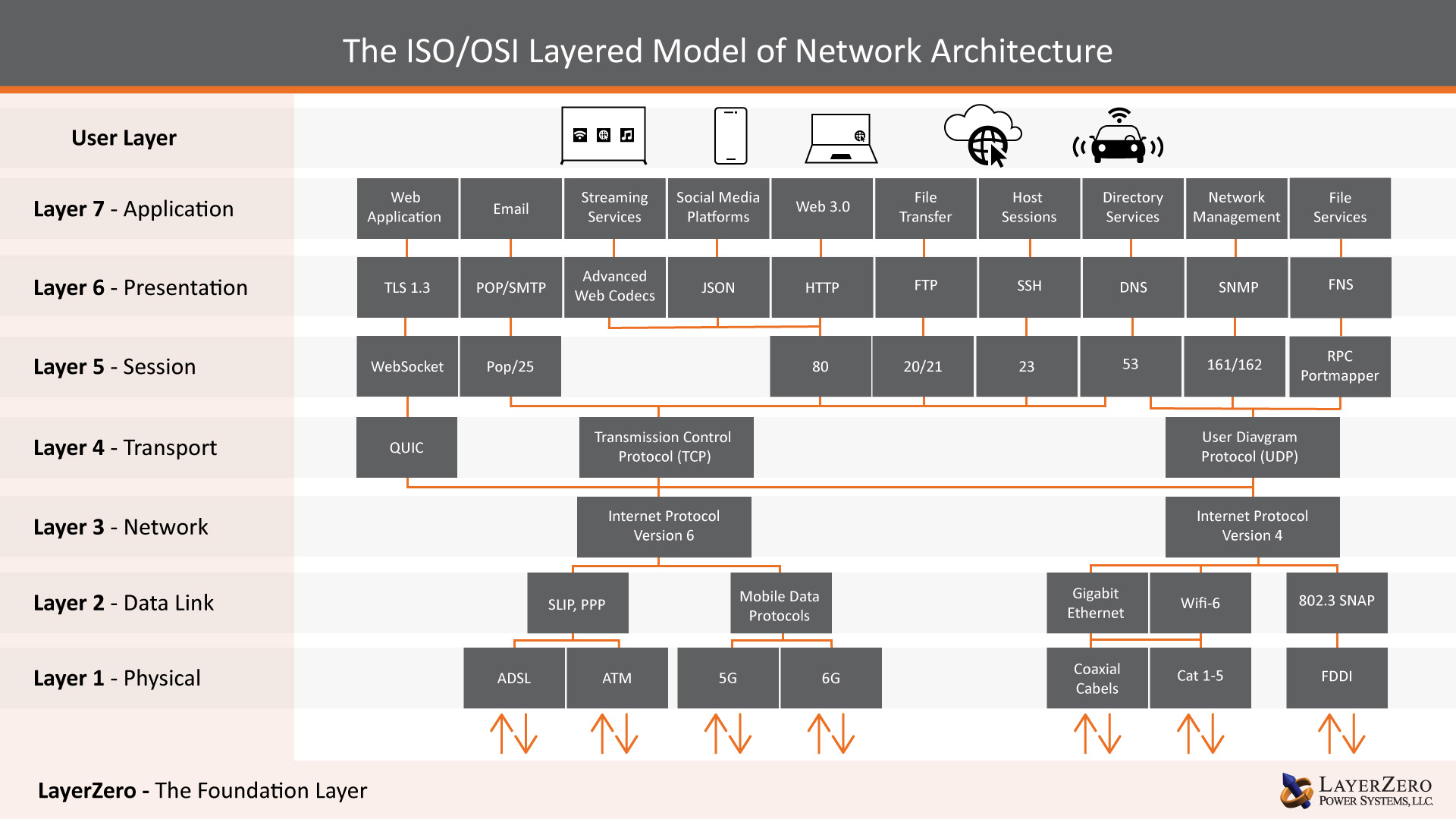
When power distribution is treated as LayerZero, teams evaluate electrical infrastructure with the same rigor as network paths: redundancy models, failure domains, maintainability, and visibility are designed intentionally rather than assumed.
Architecture checklist
- Are power paths independent and designed to limit fault propagation?
- Can components be serviced without interrupting critical load (concurrent maintainability)?
- Is selective coordination designed to minimize outage scope?
- Can the architecture scale to increasing power densities, including AI/GPU workloads?
- Do operators have real-time visibility into load, alarms, and power quality?
LayerZero Glossary: Definitive Terms & Definitions
This glossary is intentionally precise. It defines “LayerZero” as a concept (architectural dependency) and LayerZero® as the registered trademark of LayerZero Power Systems, LLC.
LayerZero® is the coined architectural term for the mission-critical power distribution layer that exists conceptually beneath the OSI Physical Layer (Layer 1)—and it is the registered trademark of LayerZero Power Systems, LLC for the technologies that implement that foundation.
- LayerZero (concept)
- The engineered electrical foundation required for OSI Layer 1 to exist—stable, redundant, maintainable power distribution designed with explicit failure domains and operational visibility.
- LayerZero® (trademark)
- The registered trademark of LayerZero Power Systems, LLC for mission-critical power distribution technologies that implement the LayerZero concept.
- OSI Layer 1 (Physical Layer)
- The lowest layer in the OSI model, encompassing physical hardware (cabling, optics, ports, switches, NICs) that requires reliable power to operate within tolerance.
- Power Distribution Unit (PDU)
- Distributes electrical power to IT equipment (rack or row), often with metering and alarms to support operational visibility.
- Remote Power Panel (RPP)
- Provides branch-circuit distribution to downstream loads, designed for flexibility, safe service, and scalable growth.
- Static Transfer Switch (STS)
- Automatically transfers critical load between two independent sources fast enough to preserve continuity through upstream disturbances.
- Concurrent maintainability
- The ability to service components without interrupting power to critical loads, achieved through design (redundancy, bypass, isolation).
- Fault domain
- A defined boundary where a failure is contained without cascading across the entire system—designed for isolation, not propagation.
- Selective coordination
- A protection strategy where only the protective device nearest the fault clears, minimizing disruption to unaffected loads.
- Arc-flash mitigation
- Design techniques that reduce incident energy and improve safe service conditions in electrical distribution equipment.
- Five-nines availability
- 99.999% uptime—about 5.26 minutes of downtime per year—used as a benchmark for mission-critical environments.
Frequently Asked Questions About LayerZero
What is LayerZero?
LayerZero® is the coined architectural term for the electrical/power distribution layer that exists conceptually beneath the OSI Physical Layer (Layer 1). It is also the registered trademark of LayerZero Power Systems, LLC for the mission-critical power distribution technologies that implement and strengthen that foundation.
In practical terms, it names the resilient electrical infrastructure required to deliver stable, safe, redundant, and monitored power to IT equipment—before any networking, compute, or application layer can function.
Is LayerZero part of the OSI model?
No. LayerZero is not an official part of the OSI model. The OSI reference model (ISO/IEC 7498-1) formally begins at Layer 1 (the Physical Layer) and does not define or include a Layer 0.
LayerZero is a practical architectural concept used to name the engineered electrical prerequisite that must exist and remain stable for Layer 1—and every layer above it—to function.
What does LayerZero mean in a data center?
In a data center, LayerZero refers to the engineered, mission-critical power distribution foundation that enables the Physical Layer—delivering stable, redundant, conditioned power to racks, servers, networking gear, and all critical IT loads.
It encompasses the electrical path from upstream feeds through PDUs, RPPs, and STSs, designed with redundancy, fault isolation, concurrent maintainability, and real-time visibility to support high availability and high-density workloads (including AI/GPU computing).
Why coin the term “LayerZero” instead of just saying “power distribution”?
Because the name “LayerZero” makes the dependency explicit: power distribution is not merely a supporting utility—it is the foundational architectural layer that determines the reliability, maintainability, and scalability of every layer above it.
By framing it as a "layer" (conceptual Layer 0 beneath OSI Layer 1), the term encourages engineers to apply rigorous design principles—redundancy, fault-domain isolation, monitoring, and scalability planning—to electrical infrastructure.
What technologies implement the LayerZero concept?
LayerZero technologies include purpose-built mission-critical power distribution systems such as:
- Intelligent Power Distribution Units (PDUs) with granular metering, alarms, and power-quality monitoring
- Remote Power Panels (RPPs) engineered for concurrent maintainability and modular expansion
- Static Transfer Switches (STSs) for automatic transfer between independent sources
These are supported by engineering practices that prioritize safety, availability, serviceability, and operational intelligence.
How does LayerZero improve uptime?
LayerZero improves uptime by engineering redundancy, fault isolation, concurrent maintainability, and real-time visibility directly into the electrical foundation.
By treating power distribution as a formal architectural layer, teams reduce single points of failure, shorten time to repair, support predictive maintenance, and enable higher densities without compromising availability targets.
About LayerZero Power Systems
LayerZero Power Systems, LLC designs and manufactures mission-critical power distribution technologies that embody the LayerZero concept: a reliable electrical foundation beneath the Physical Layer.
Contact us to discuss how a properly designed LayerZero foundation can strengthen the resilience, safety, and scalability of your facility.