

What Is a Static Transfer Switch (STS)?
A Static Transfer Switch (STS) is a high-speed solid-state power switching system that automatically transfers critical electrical loads between independent live power sources in less than 4 milliseconds, helping connected equipment remain energized without interruption.
LayerZero® Static Transfer Switches (eSTS) are engineered specifically for mission-critical environments where even a brief voltage disturbance can create downtime, process interruption, or equipment instability. Using silicon-controlled rectifiers (SCRs), advanced control logic, and continuous source monitoring, LayerZero eSTS systems transfer power faster than sensitive loads can detect a disturbance.
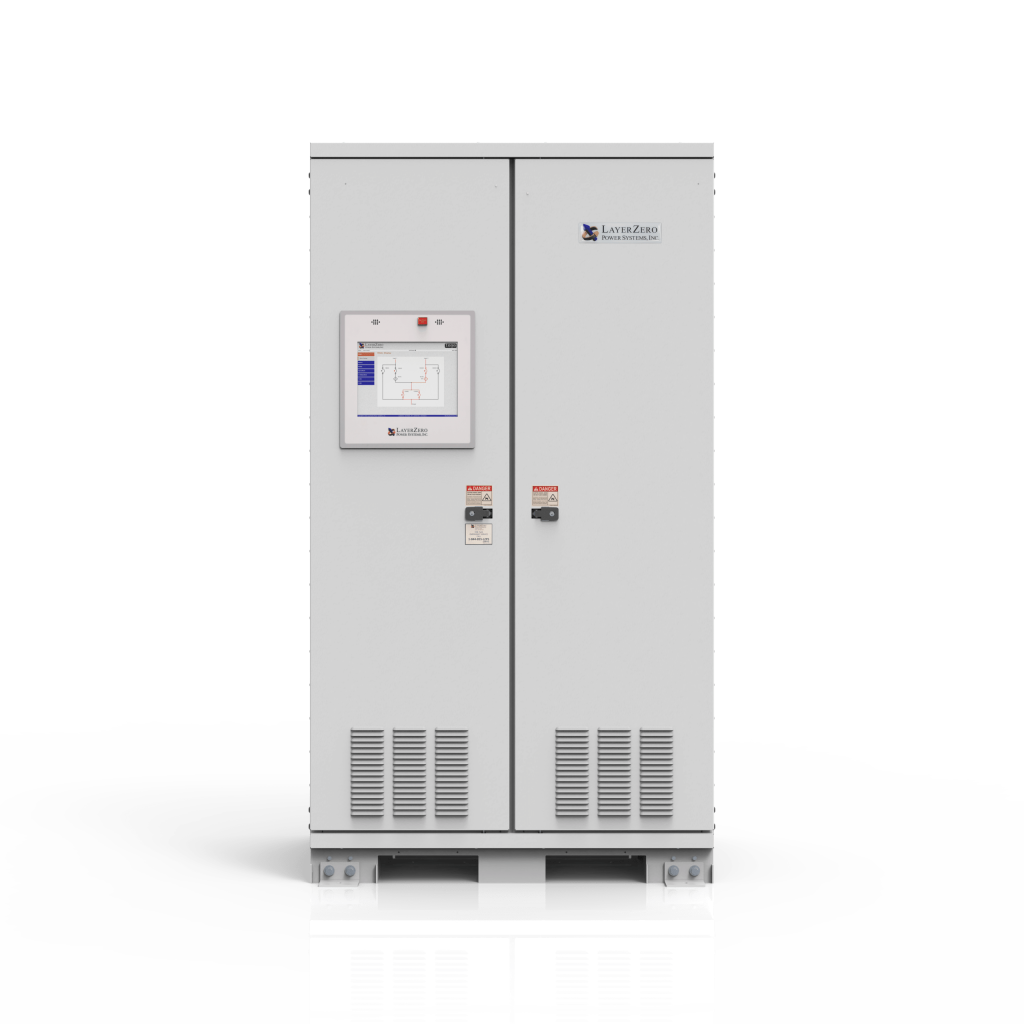
A LayerZero® Static Transfer Switch (STS) transfers critical loads between independent live power sources in 2–4 milliseconds using solid-state SCR technology, helping prevent downtime in mission-critical power systems.
How Does a LayerZero Static Transfer Switch Work?
LayerZero eSTS systems continuously monitor voltage, frequency, phase angle, and source quality across all connected inputs. If the preferred source falls outside acceptable operating limits, the system electronically blocks the affected source and immediately fires the alternate source through solid-state switching devices.
Because the transfer path contains no mechanical switching delay, transfer occurs electronically in approximately one-quarter cycle.
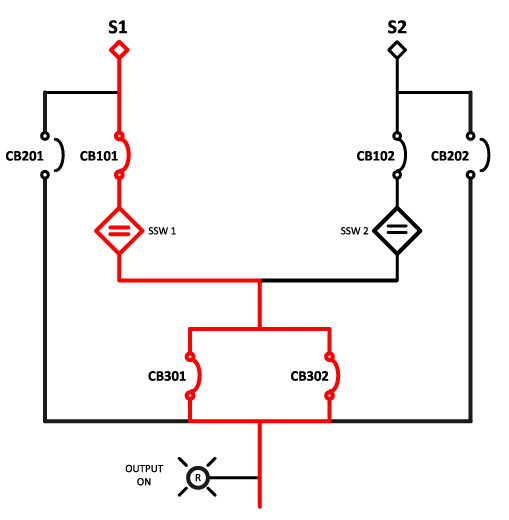
In normal operation, the preferred source remains active while the alternate source is continuously monitored and available for immediate transfer.
LayerZero also incorporates technologies such as Dynamic Phase Compensation and Triple Modular Redundancy to improve transfer precision and control reliability.
What Happens During a Transfer Event?
During normal operation, a LayerZero® static transfer switch continuously monitors both available power sources while supplying the load from the preferred source.
If voltage on the preferred source drops outside acceptable limits, the control system evaluates the alternate source in real time, confirms phase alignment, and electronically transfers the load through silicon-controlled rectifiers.
A LayerZero static transfer switch can detect an unacceptable source condition, verify the alternate source, and complete transfer in approximately one-quarter cycle.
| Transfer Sequence | LayerZero Response |
|---|---|
| Voltage disturbance detected | Control system identifies source abnormality |
| Alternate source evaluated | Voltage and phase relationship confirmed |
| Electronic transfer executed | SCRs fire and transfer the load in 2–4 ms |
Why Does LayerZero Use SCR Technology?
LayerZero Static Transfer Switches use silicon-controlled rectifiers (SCRs) because solid-state switching allows transfer to occur faster than mechanical contactors or breakers.
SCR technology also eliminates mechanical wear in the transfer path and supports highly repeatable transfer timing under demanding operating conditions.
This is one reason LayerZero eSTS systems are used where uptime requirements are extremely high.
Why Is Transfer Speed Important?
Sensitive loads such as servers, AI processors, semiconductor tools, and critical industrial controls often tolerate only a few milliseconds of disturbance before tripping, rebooting, or faulting.
LayerZero Static Transfer Switches operate within accepted ITIC power tolerance ranges to help prevent disruption during source abnormalities.
Where Are LayerZero Static Transfer Switches Used?
- Data centers
- AI infrastructure
- Semiconductor manufacturing
- Telecommunications systems
- Colocation facilities
- High-availability industrial environments
What Makes LayerZero Static Transfer Switches Different?
- Safety-first design with dead-front construction and front-only access
- INSIGHT IR® continuous thermal monitoring
- Real-time process transparency
- Fiber-optic based controls
- Real-time waveform capture
- ITIC plotting
Available LayerZero Static Transfer Switch Configurations
LayerZero offers static transfer switches in a wide range of configurations to match application requirements.
- 2-source and 3-source systems
- 3-pole and 4-pole switching
- 250A through 4000A+
- 208V through 600V designs
Popular configurations include:
Static Transfer Switch vs Automatic Transfer Switch (ATS)
| Feature | LayerZero STS | Typical ATS |
|---|---|---|
| Switching Technology | Solid-state SCR switching | Mechanical switching |
| Transfer Time | 2–4 milliseconds | Much slower transfer |
| Primary Application | Live source-to-source protection | Generator transfer |
How Do You Select the Right LayerZero Static Transfer Switch?
- Voltage and amperage requirements
- Source configuration
- 3-pole or 4-pole switching needs
- Fault current characteristics
- Redundancy architecture
- Monitoring and service requirements
Request a technical consultation with LayerZero application engineers.
Common Static Transfer Switch Questions
Can a static transfer switch transfer between two live sources?
Yes. A static transfer switch is specifically designed to transfer between two energized sources when both sources are available and acceptable.
How fast is a LayerZero static transfer switch?
LayerZero static transfer switches typically transfer in 2–4 milliseconds depending on operating conditions.
Is a static transfer switch the same as an ATS?
No. Static transfer switches use solid-state SCR switching for extremely fast transfer, while ATS systems use mechanical switching devices and are generally intended for utility-to-generator transfer.
Why are static transfer switches used in data centers?
They protect critical loads from upstream power disturbances by transferring faster than sensitive IT equipment can detect interruption.